- myBITZER
- BITZER SOFTWARE
-
ePARTS
A funcionalidade ePARTS faz com que seja mais fácil e rápido encontrar as peças de substituição adequadas para os nossos produtos. As peças encontram-se listadas segundo a gama de modelos e são apresentadas como um desenho simples ajustável, de vista explodida. O software é gratuito. Como cliente direto da BITZER registado na myBITZER, beneficia de funcionalidades avançadas adicionais, como por exemplo a capacidade de consultar online os preços de cada peça de substituição.
- Documentação
- Contato
- Germany (de)


Efficient capacity control saves energy and reduces consumption costs
Delivery address
We are BITZER - shaping the future with you
With legal requirements growing increasingly stringent, energy costs on the rise and sustainability activities expanding, the energy efficiency of refrigeration, air conditioning and heat pump systems plays an important role in the financial success of contractors and end users. There is significant potential in the details – both for new and existing systems. BITZER provides its customers and partners with energy-efficient components and technologies to ensure growth in their business and thus strengthen their market position over the long term.
Energy efficiency is essential to fulfilling the minimum efficiency performance standards (MEPS) and the future requirements of the new EU Ecodesign for Sustainable Products Regulation (ESPR). An investment in efficiency offers contractors and end users lots of added value, including a drop in operating costs and a reduction in energy consumption. In addition, it is often worth the effort to thoroughly assess and systematically retrofit existing systems, as they frequently offer untapped potential for efficiency. Energy-efficient systems also benefit the environment. Fig. 1 shows the shares of direct and indirect emissions, using, as an example, a semi-hermetic reciprocating compressor which has been operating with the refrigerant R454C for 15 years. The figure illustrates that indirect emissions account for a particularly large share due to energy consumption. Because the compressor is usually the main consumer in the refrigeration system, this calculated result can also be applied to the system as a whole. High energy efficiency in the system is therefore a decisive element when it comes to reducing negative environmental effects.
With efficient and robust compressor designs and intelligent solutions such as
- VARISTEP mechanical capacity control,
- the external VARIPACK frequency inverter and
- the IQ MODULE CM-RC-02,
BITZER offers an optimally coordinated energy-saving package for new and existing systems, supporting its customers and partners in realising particularly energy-efficient systems.
An example taken from the supermarket refrigeration sector reveals changing system requirements designed to increase energy efficiency. Around 15 years ago, the primary focus here was a simple system design and high availability. At that time, R404A racks with 4-cylinder reciprocating compressors were quite common. Compressor operating parameters were individually programmed and monitored in the system controller. The capacity was adjusted by switching on or shutting off the compressors or with simple mechanical capacity control.
These days, modern supermarkets increasingly use highly efficient CO₂ systems such as booster systems with flash gas bypass (FGB) and systems with parallel compression or ejectors. Solutions that combine cooling, air conditioning and heating are also on the rise.
Both energy-efficient components and energy-efficient operations play a key role in the system’s energy efficiency. In fact, BITZER compressors have always been developed with a special focus on efficiency and durability. One example is the
ECOLINE+ reciprocating compressor series with line-start permanent-magnet (LSPM) motor technology: It uses high motor efficiency and low heat input into the refrigerant to reduce energy consumption. To ensure efficient operation, the compressor or rack’s refrigeration or heating capacity should cover the variable system demands with precision at all times. A wide modulation range is essential, as is fine capacity control with minimal capacity jumps when switching on or shutting off compressors.
The aim is to cover demand with precision, from minimum to maximum load, if possible without any loss-inducing fluctuations in pressure and temperature differentials in heat exchangers and with as few operating and starting cycles as possible. This can be achieved with modern methods for controlling compressor and rack capacities. The idea is to minimise deviations from the specified set point or, ideally, adjust the set points for optimum efficiency – for example, by raising the average evaporation temperature or lowering the average condensing temperature. This ensures constant operation and thus reduced energy consumption.
Fig. 2 illustrates these correlations: If there are large fluctuations, the average evaporation temperature will need to be set lower to maintain the defined set point at all times and, for example, ensure product quality (see the left-hand section of the diagram). As the average evaporation temperature decreases, so too does system efficiency. In contrast, smaller fluctuations in evaporation temperature and suction pressure – thanks to modern capacity control – allow you to select a smaller deviation between the average evaporation temperature and the set point. Maximum system efficiency occurs when the average evaporation temperature matches the set point (see the middle and right-hand sections of the diagram).
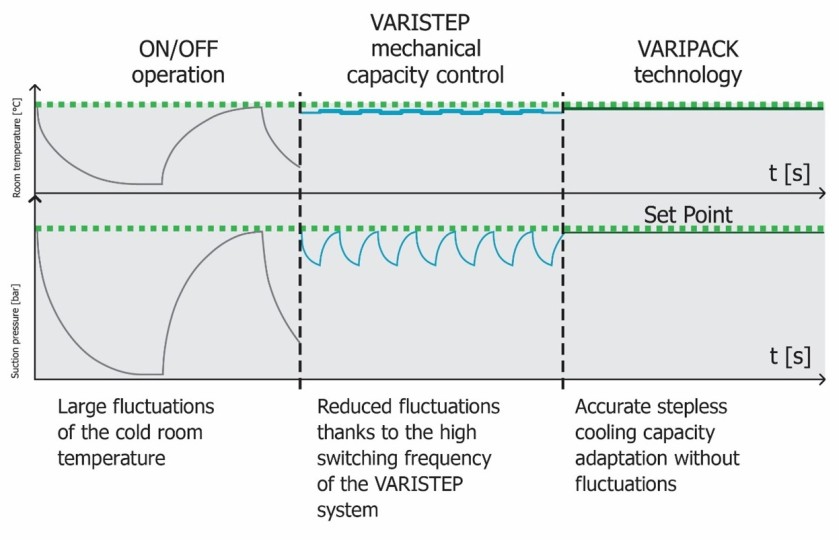
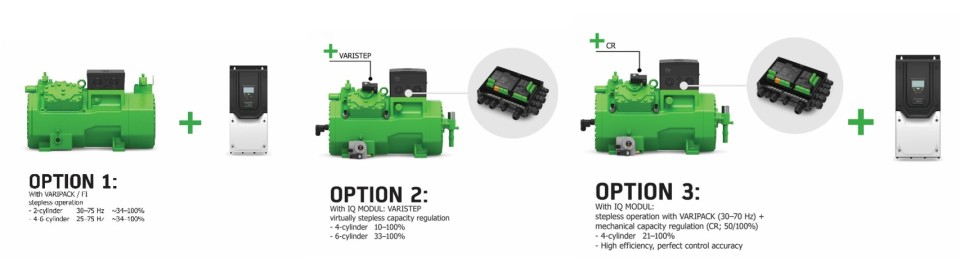
With the external VARIPACK frequency inverter and the virtually stepless VARISTEP mechanical capacity control, BITZER offers a variety of options optimally tailored to its compressors for a wide modulation range and fine capacity control. Fig. 3 features options using CO₂ compressors as an example.
- Option 1: The external frequency inverter VARIPACK is precisely adapted to the motor characteristics of BITZER compressors and enables stepless capacity control between 34 and 100%. The combination with VARIPACK enables trans-synchronous compressor operation at up to 70 Hz, which makes it possible to choose a compressor with lower displacement and thus reduce costs.
- Option 2: Another option is to connect the virtually stepless VARISTEP capacity control using the IQ MODULE – for example, to enable a modulation range between 10 and 100% for ECOLINE 4-cylinder compressors. In this case, CR100 operation corresponds to direct mains operation at 50 Hz.
The CM-RC-02 IQ MODULE is used to control compressor-fitted accessories, offers protective functions and supports installers and contractors with a user-friendly operating concept and helpful digital services in their daily work. Optional accessories such as VARISTEP capacity control can easily be connected using separately available extension boards, without wiring effort in the switch cabinet, and operated directly with the module. Extension boards offer a wide range of functions and can be added when placing an order for a new compressor or at a later date. The IQ MODULE also makes it easier to retrofit an existing system with capacity control.
- Option 3 in Fig. 3 also shows that even a combination of stepped CR capacity control and VARIPACK is possible. The external frequency inverter enables trans-synchronous compressor operation at up to 70 Hz. Thanks to stepped CR capacity control and VARIPACK, 4-cylinder reciprocating compressors can be operated steplessly between 21 and 100%, and the minimal capacity significantly reduced. When it comes to single-compressor systems optimised for seasonal efficiency, the wide modulation range is particularly advantageous in terms of energy. Outstanding annual performance figures (SCOP, SEER, SEPR) can therefore be achieved for heat pumps and liquid chillers.
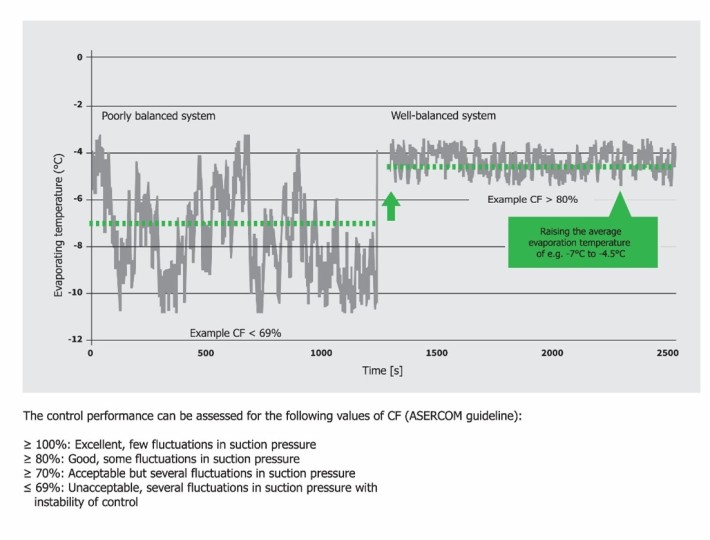
Rather than a larger number of smaller compressors, compound systems increasingly comprise a smaller number of larger compressors – for example, to reduce costs or introduce a shared-parts strategy – which can increase the number of operating times for the lead compressor in the case of minimal requirements and significant load fluctuations. These frequent operating times usually result in strong fluctuations in the evaporation temperature and thus system operation with low efficiency.
The ASERCOM guideline and a simple formula can be used to determine control accuracy (CF). It is
- the difference between the capacity of the lead compressor at maximum and minimum frequency,
- divided by the capacity of the secondary compressor.
The left-hand section of Fig. 4 provides an example of fluctuations in the evaporation temperature in a poorly balanced system (CF < 69%). In this case, the average evaporation temperature should be –7°C. In joint practical projects with partners and through in-house testing with demonstration systems at the SCHAUFLER Academy, BITZER has revealed that VARISTEP can significantly improve accuracy in system control.
As shown in the right-hand section of Fig. 4, a VARISTEP retrofit often allows to raise the average evaporation temperature by up to 3 K. Additional calculation with the BITZER SOFTWARE reveals that the rise in evaporation temperature of 3 K can increase system efficiency by up to 12%, whilst reducing the condensing temperature by 1 K can improve system efficiency by another 2 .. 3%.
Due to increasing energy prices, it is also important to maintain and possibly even increase the energy efficiency of existing systems throughout their lifetime. At the same time, measures should be taken to minimise the amount of refrigeration and heating required by consumers. For example, refrigerated display cabinets at supermarkets are often fitted with glass doors to reduce ‘loss of cooling’ and thus optimise energy consumption. This decreases the refrigerating capacity necessary by 40 .. 50%, depending on the temperature class and evaporation temperature.
As a result, glass doors can lead to an unacceptable number of compressor starts and very short operating cycles, which can have a negative impact on oil transport and thus system availability. To increase system availability and efficiency, it may make sense in some cases to retrofit the compressor rack when installing glass doors. One approach in the aforementioned example would therefore be to replace the outdated system’s lead compressor with a highly efficient
ECOLINE+ compressor featuring VARISTEP and potentially choose a compressor with a reduced displacement volume. ECOLINE+ reciprocating compressors come fitted with the new generation of the
IQ MODULE as standard, which makes it easier to connect VARISTEP capacity control using the corresponding extension board – without the need for complex changes inside the switch cabinet. In addition, the secondary compressor, too, could be fitted with stepped capacity control to further increase control accuracy (CF).
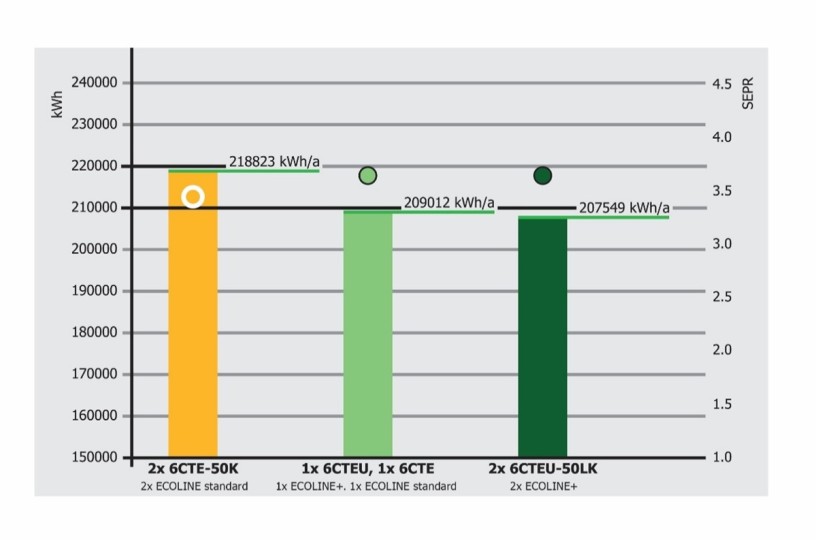
The example calculation in Fig. 5 reveals the potential to save energy when using LSPM compressors. Take, for instance, a parallel compounding comprising two 6-cylinder reciprocating compressors – one operated with an external frequency inverter and one with mains operation at 50 Hz (Strasbourg climate zone, SEPR calculation based on EN13215). With an annual compressor running time of 8760 h for the lead compressor and 1600 h for the secondary compressor, the energy consumption of the two compressors with asynchronous motor is around 218,823 kWh (yellow column). Replacing the lead compressor with an ECOLINE+ compressor with LSPM motor results in annual savings of around 10,000 kWh (light-green column). Further savings can be achieved when using two ECOLINE+ compressors in parallel compounding (dark-green column).
Soluções eficientes para as suas aplicações
Os desafios da indústria de refrigeração e climatização são múltiplos, de forma que as soluções também o devem ser. Com seu amplo portfólio de produtos e serviços, a BITZER disponibiliza soluções adequadas para cada aplicação.


