Safety references especially for the use in zones 1 and 2
 DANGER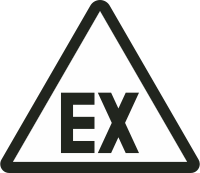
Risk of explosion due to hot surfaces!
The surface temperature of 130°C must not be exceeded at any point!
DANGERRisk of explosion due to spark formation!
Avoid ignition sources and open fire!
Use only low-sparking tools!
Mobile phones must be switched off!
DANGERRisk of explosion due to dust and oil!
Avoid all contamination!
Clean the whole system as needed but at least every six months.
DANGERRisk of explosion due to the discharge of electrostatic charges!
Use only devices suitable for potentially explosive atmospheres and assess and list them in the explosion protection document of the end user!
Do not operate the devices in the vicinity of processes producing high charges (e.g. mechanical separation processes)!
Take measures against electrostatic charging of non-metallic components, tools, auxiliaries and clothing!
Wear, for example, suitable antistatic clothing, use low-sparking tools, a moist cloth for cleaning, and perform additional earthing of conductive parts.
DANGERExplosion hazard due to prevailing flammable atmosphere!
EX work must be carried out in a measured environment.
- This means that a gas detector must be used to ensure that there is no flammable atmosphere.
In addition to the EU Explosion Protection Directive , the specific regulations EN 60079, EN ISO 80079-36 / -37 and the EU must be observed!
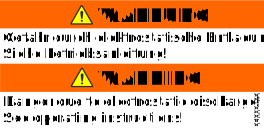
The following components can become electrostatically charged:
- Name plate (5% of aluminium content and additional protective laminate made of PTFE)
- Other adhesive labels (oil level, hot surfaces, etc.)
The following standards have been applied:
- EN 1127-1: 2019
- EN IEC 60079-0:2018
- EN 60079-1:2014
- EN 60079-7:2015, EN IEC 60079-7:2015+A1:2018
- EN 60079-11:2012
- EN 60079-18:2015, EN 60079-18:2015+A1:2017
- EN ISO 80079-36:2016
- EN ISO 80079-37:2016