To be noted for R717
 DANGER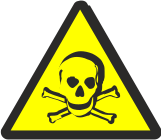
Danger to life in case of refrigerant leakage!
Ammonia (R717) is toxic and, when present in high concentration, causes burns to the skin, mucous membranes and eyes and leads to paralysis and suffocation!
In liquid form, it can cause frostbite on contact with the skin!
When working on the system: Wear personal protective equipment!
Equip the machinery room and the hazardous area according to EN378-3, 5.17!
- From a refrigerant charge of 50 kg, install a gas warning system!
- From a refrigerant charge of 500 kg, take additional measures to detect possible ammonia contamination in all connected water or liquid circuits!
Since ammonia (R717) is lighter than air, the contaminated air must be extracted below the ceiling and supply air is introduced at floor level.
For refrigeration systems with R717 (ammonia) there are some important differences to consider, which are mainly due to the special properties of R717. The following (among other requirements) applies to the pipe network:
- Refrigerant lines, heat exchangers and fittings should be made of steel or stainless steel (or aluminium if necessary).
- Pipes and fittings need a test certificate according to DIN EN10204/3.1.
- Use resistant plastic materials or elastomers.
- Piping, refrigerant pumps and control components are dimensioned relatively small.
- Use high quality shaft seals, gaskets and packing gland.
- Install automatic venting device.
- Use short, well-insulated suction gas lines (for low pressure losses).
- Run suction gas lines with a gradient and above the compressors - not below as is usual with other refrigerants.
- Due to the high electrical conductivity, observe special requirements for electrical components within the refrigeration circuit (e.g. canned pumps).
- Since R717 is insoluble in most oils, special oils must be used.
- Adapt heat exchanger and expansion elements to mass flow and volume ratios. Design heat exchangers for small temperature differences (low pressure ratio) and low suction gas superheat.
- Preferably, heat exchangers should be of the flooded or pumped type.
- In the case of flooded evaporators, use highly efficient oil separators and ensure oil return from the system (automatically or manually during regular maintenance).
- For compact units with dry or partially flooded evaporators, use oils with good flow properties, if necessary with special oil separation and recirculation devices.
In systems with a dry evaporator, the highest demands are placed on the refrigerant distribution, especially in the case of highly subcooled liquid (e.g. 2-stage, economiser operation). - Take suitable protective measures against wet operation and liquid hammer (use suction accumulators and expansion devices with stable control behaviour).
Work carefully and avoid penetration of water and/or air humidity into the system!
Ammonia (R717) is strongly hygroscopic!
Work carefully and avoid penetration of water and/or air humidity into the system!
A high water content in ammonia systems modifies the evaporation temperature and reduces system efficiency, especially for low temperature applications!
Moreover, water can only be removed with great effort using so-called system cleaners or by renewing the refrigerant charge!
- When draining R717 into water, use a check valve.
- System parts to be opened must be flushed with dry nitrogen first.
- Avoid the formation of condensate! Let cold components warm up.
- Evacuate the system carefully before (re-)commissioning.
- Due to the special conditions in compact air conditioning systems, high demands are placed on the dryness (use R717 with a water content of max. 400 ppm)!
For detailed information on the use of R717:
- AT-640: Use of ammonia (R717) in Bitzer compressors