HS.85, OS.85, CS.65 .. 96
These compressors are equipped with a "dual capacity control" with slider as standard. This means that - without converting the compressor - both stepless and 3- or 4-step control is possible. The different operating modes are achieved by controlling the 4 solenoid valves accordingly. The automatic start unloading made possible by the slider significantly reduces starting torque and acceleration times - this protects the mechanics and the motor and reduces the load on power supply.
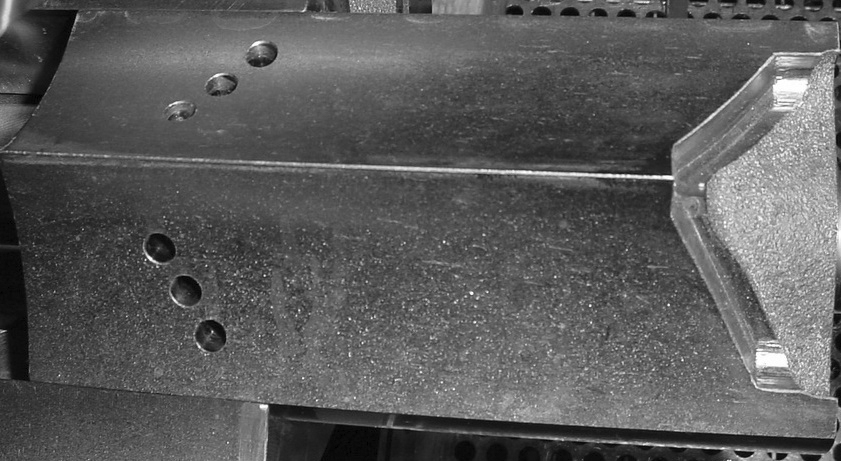
CR slider
The CR slider is placed parallel to the rotor axes between male and female rotor, and it is fitted exactly to the contour of the housing. The special geometry of the slider allows the internal volume ratio Vi to be changed as required and ensures high efficiency even at part load (depending on the application). The partly integrated ECO port enables economical ECO operation over the entire control range.
The following figure shows the control with a simplified view of the unwound outer surfaces of the rotors.
SL: suction gas line
DL: discharge gas line
Hydraulic scheme
The capacity control is operated via solenoid valves CR 1 .. 4 which are flanged to the compressor.
The hydraulic piston controls the CR slider and thus the suction gas volume:
- At full load, the slider is in the left stop position (suction side). When the rotors turn, the entire profile space is filled with suction gas (100% delivery rate).
- Depending on the control of the valves CR1, CR2 or CR3, the hydraulic piston moves to the corresponding bore. The discharge gas and the spring move the slider to the high pressure side on the right. The further it moves, the smaller the available profile volume or the active rotor length – less refrigerant is conveyed, mass flow and refrigerating capacity decrease.
- If valve CR4 is open, pressure in the pressure chamber increases. The slider is pushed towards the suction side, the refrigerating capacity increases.
- For stepped control, CR4 is opened intermittently (e.g. 10 s). For stepless control, CR2, CR3 or CR4 are opened pulsatingly (e.g. 0,5 s).
Start unloading
At standstill and during start, solenoid valve CR3 is open, the pressure in the hydraulic cylinder is completely released. The spring pushes the slider all the way to the high pressure side (if necessary, observe the pause time according to the operating instructions). When switched on, the compressor starts unloaded. If necessary, valve CR4 is activated and the slider is moved to the suction side. By activating valves CR1, CR2 or CR3, the refrigerating capacity increases to the preset level.
3- or 4-stepped capacity control
Stepped capacity control is particularly suitable for systems with a large inertia, e.g. for indirect cooling such as liquid chillers. For parallel operation of several compressors (compound systems), the difference in capacity per step is very small in relation to the total capacity, so that almost stepless control is possible. The comparatively simple control logic is essential here.
The 4-step control allows nominal capacities of 25%, 50%, 75% and 100%. The 25% step functions primarily as start unloading.
The capacity steps given here are the nominal ones. The effective capacity steps depend on the operating conditions.
The 25% step also applies to standstill and start.
Blue: suction gas
Red: discharge gas
Yellow: oil pressure
CR3 must be open during standstill. The slider is reset to start unloading by the spring force. Due to the economiser port in the slider, economiser operation is also possible at part load.
When and at what time intervals to switch between capacity steps must be carefully adapted to the inertia of the respective system. The cycle time of valve CR4 should be set to about 20 s before commissioning, i.e. 10 s pulse and 10 s pause. In general, individual adjustment is necessary according to the system. Especially in systems with a high pressure difference, shorter intervals may be necessary, so adjustable time relays should be used here.
It is often advisable to limit the minimum refrigerating capacity to approx. 50% here (see application limits in the BITZER SOFTWARE). The control is then carried out analogously with the valves CR4 (intermittent) as well as CR1 (75%) and CR2 (50%). With R717, 50% is always the minimum, 25% is only possible during start.
Stepless control
Stepless capacity control is recommended for systems with single compressors that require a high control accuracy. The solenoid valves CR3 and CR4 control between 100% and 25% (nominal values), the valves CR2 and CR4 between 100% and 50% (nominal values). By opening and closing the corresponding solenoid valve (CR3 and CR4 or CR2 and CR4) pulsatingly, the control piston is energised from the appropriate side in short time intervals. The slider is moved a little further with each impulse. The principle is shown in the following figure.
(1): controlled value
(2): control thermostat, signal output to timer
(3): CR solenoid valves (pulsating), controlled by timer
A .. D: operating conditions
X: controlled value (e.g. air / water temperature at evaporator or suction pressure)
Xset: set point
Xmax: upper switching point
Xmin: lower switching point
Xreal: actual value
H: set control range
CAP: cooling demand (increased, unchanged, reduced)
ON: CR solenoid valve open
OFF: CR solenoid valve closed
T: time
T1, T3: pulse time (ca. 0,5 s .. max. 1s), solenoid valve opened
T2, T4: pause time, solenoid valve closed
- If the actual value of the controlled value X is within the set range H, the cooling demand of the system is unchanged. The slider does not have to be moved, no solenoid valves are energised.
- If the actual value exceeds the upper switching point, there is increased cooling demand (operating condition A in fig. above). Solenoid valve CR4 is opened in short intervals, until the actual value is within the set range again (operating condition B). The compressor operates with increased capacity.
- In the case of reduced cooling demand, the lower switching point is undercut (operating condition C). Now the solenoid valve CR3 opens for short intervals, until the lower switching point is exceeded again (operating condition D). The set range is then reached again, and the compressor operates with reduced capacity.
It is recommended to use a PID controller (proportional-integral-differential controller) – otherwise pay attention to the following:
- Travel times of the slider are short. The pulse times (T1, T3) should be in the range of 0.5 s, but never exceed 1 s.
- The pulse time between two pulses (T2, T4) must be carefully and individually adapted to the inertia of the respective system.
- In order to avoid short cycling, following pulses should occur depending on the deviation of the controlled value, taking into account the inertia of the system.
In the following cases, refrigerating capacity should be limited to min. 50%:
- For all R717 systems (except at start).
- For HSN85 and OSN85 because of the high pressure ratios: The compressor has to start at the 25% step (CR3 is energised during standstill).
- For operation of HSK85, OSK85 and CS.65 .. 96 with high pressure ratios resp. high condensing temperature, e.g. regarding the thermal application limits (see BITZER SOFTWARE).
- For systems with several compressors in separated circuits or in parallel compounding.
The capacity control 50 .. 100% in conjunction with switching individual compressors on and off enables a particularly economical operation mode here – without significant restrictions in application range.
Parallel compounds of HSK or OSK: If only the lead compressor remains in operation, it can also be operated very effectively down to a nominal 25% residual capacity (with valves CR3 and CR4) – due to the usually lower condensing temperature in part load of such systems.
Control with solenoid valves
The arrangement of the solenoid valves on the discharge flange can be found in the dimensional drawing of the respective compressor, e.g. in the BITZER SOFTWARE. On many new compressors, the connections of the solenoid valves are also labelled on the housing with 25%, 50%, 75% and 100%. Which solenoid valves must be energised and de-energised for the desired capacity is shown in the respective operating instructions: