Pipe layout and further components
Pipe layout
Risk of compressor failure due to liquid slugging!
Before adding larger quantities of oil: check the oil return!
Pipes and system design must ensure that the compressor cannot be flooded with oil or liquid refrigerant from the suction or discharge side. This needs to be guaranteed during
- standstill,
- start,
- 4-way valve switching or defrost cycles.
The following measures should be taken:
- Install the compressor above the evaporator or raise the suction gas line after the evaporator (see sketch below).
- Do not install the compressor in the coldest part of the system and provide thermal insulation, if necessary.
- Install an oil heater and combine it with a single pump down system, if necessary (Pump down system).
- Provide a suction accumulator in reversible and heat pump systems with defrost cycles if needed.
- Ensure adequate oil return to the compressor, especially at minimum load conditions (e.g. operation with frequency inverter at 35 Hz).
Additional safety is provided by a solenoid valve mounted directly prior to the expansion valve.
Risk of compressor damage due to insufficient oil return!
The end user is responsible for ensuring proper system oil charge and oil return for all operating speeds and conditions.
Discharge gas line
Pipes should be installed with a certain inclination leading away from the compressor in order to prevent liquid refrigerant (caused by possible back condensation) or oil from migrating to the discharge chamber of the compressor. If a larger amount of liquid accumulates, this results in extremely high pressure peaks during start, which may lead to compressor damage and pipe fracture.
For further information, please contact Bitzer.
Pressure pulsations may lead to vibrations in the discharge gas line. Critical pipe lengths whose natural frequencies are in resonance with the compressor pulsations, must be avoided. For further details: Vibrations and sound.
Suction gas line
To ensure continuous oil circulation in the system and to protect the compressor from being flooded with refrigerant, consider the measures described above as well as the suction gas line versions shown in the following figure.
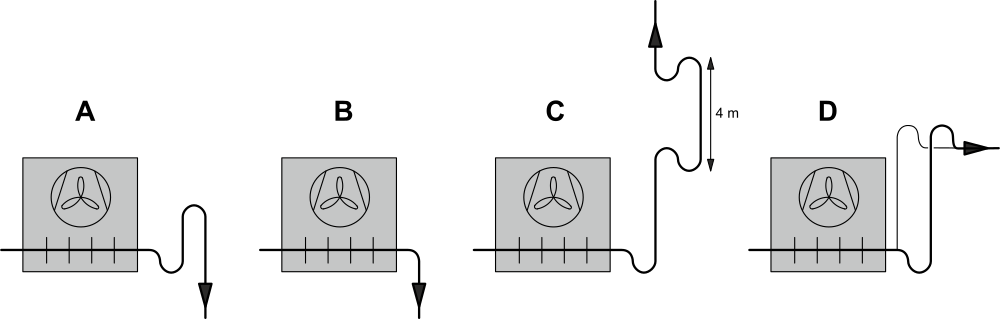
A: Raised suction gas line (swan neck)
B: Falling suction line – single pump down system or specific evaporator design required
C: Rising line
D: Split rising line for part load resp. systems with capacity control (e.g. compound operation or operation with external frequency inverter)
Oil heater
The oil heater ensures the lubricity of the oil even after long shut-off periods. It prevents increased refrigerant concentration in the oil and therefore reduced viscosity. The oil heater should be operated while the compressor is at standstill and at least 12 h prior to the first compressor start. For the following cases it is absolutely necessary:
- outdoor installation of the compressor
- systems with reverse cycling (e.g. hot gas defrosting)
- if the compressor can become colder than other system components
- extended pipe works (e.g. split systems)
- long shut-off periods
- high refrigerant charge compared to the system volume
- possible refrigerant condensation in the compressor
For more information on oil heaters:
- ESB-130: Operating instructions Hermetic scroll compressors Orbit 6 and Orbit 8
Filter dryer
The polyvinyl ether oils (PVE) in Orbit compressors are strongly hygroscopic, i.e. they withdraw water from ambient air.
Risk of compressor damage!
Generously sized filter dryers should be used to ensure a high degree of dehydration and to maintain the chemical stability of the circuit. Make sure to choose a suitable quality (molecular sieves with specially adapted pore sizes).
Replaceable core filter driers are generally considered the best option on larger capacity systems with multiple compressors. For more information on Bitzer oils:
- EST-500: BITZER refrigeration compressor oils for scroll compressors, stationary applications (ORBIT, ESH7)
Suction side cleaning filter
A suction side cleaning filter (filter mesh 25 μm) will protect the compressor from damage due to dirt from the system and is strongly recommended for individually built systems with widely branched pipe works. Accessability for exchange is recommended. The use of suction screens should not be considered as a substitute for proper pipe processing and cleanliness in brazing and design!
Expansion valve and evaporator
Expansion valve and evaporator have to be tuned-in using utmost care, especially for systems with a large control range. Sufficient suction gas superheat and stable operating conditions must be guaranteed in each case in full and part load conditions (e.g. with tandems, trios or operation with frequency inverter).
After switching from part to full load, liquid slugging can occur. Therefore, the evaporator must be sized in such a way that even at part load no oil is trapped in the evaporator. Depending on design and performance range of the evaporator, several circuits may be necessary, each with separate expansion and solenoid valve, or tight closing electronic expansion valve, respectively.
Check valve
ORBIT scroll compressors are equipped with an internal discharge check valve. The valve is intended to prevent an excessive leak rate of the high-pressure gas into the compressor when it is turned off. Low pressure differentials may cause leak rates over longer time. An external discharge check valve is recommended for pump down and in applications with long standstill times and reversible systems, with potential refrigerant migration.
Operation with electronic soft starter or external frequency inverter
The soft starter reduces the starting current for the motor by increasing the motor voltage up to the nominal value according to predefined functions. A frequency inverter allows the stepless control of the refrigerating capacity to the cooling demand of the system by speed control. Not all compressor protection devices are suitable for operation with soft starter or frequency inverter.
For more information:
- AT-330: Starting modes for BITZER compressors
- EST-420: Bitzer scroll compressors with external frequency inverters
- CT-120: Protection devices for BITZER compressors
When operating compressors with soft starter or external frequency inverter, consult Bitzer.