HFC phase down according to the EU F-Gas Regulation
- Due to the requirements of the EU F-Gas Regulation 517/2014 and 2024/573, especially the gradual reduction of the of consumtion (phase down) and the resulting prohibitions of use, refrigerants with high GWP (Global Warming Potential) will widely have to be withdrawn from the European market.
- The higher the GWP of the refrigerant, the higher the impact of the HFC phase-down.
- Consequently, refrigerants with high GWP such as R404A and R507A, as well as HFC blends with lower GWP, will become increasingly scarce.
- In many cases a conversion to refrigerants with low GWP is possible.
New F-Gas Regulation 2024/573 of 2024-02-20
Here the most important contents for refrigeration, air conditioning and heat pumps are collected. The text is available in all official languages of the EU.
The phase down scenario is adjusted slightly in the single steps from 2025 on compared to the Commission Draft of 2022-04 and has become a phase out scenario for HFC until 2050. In the quota for allowed emissions now also the amount for medical dose inhalers (MDI) of ca 10.5 Mt CO2 equivalent is included. The document lists maximum emission values until 2049 and the value 0 from 2050 onwards. A revision of the scenario is scheduled for 2030.
The number of application related use bans is remarkably enlarged versus the current Regulation. Some definitions have been modified. Some of the definitions for applications and systems are still not unambiguous. Some applications will have to completely quit the use of fluorinated greenhouse gases (FGG).
Further new requirements:
- Export ban for stationary refrigeration, stationary air conditioning equipment and stationary heat pumps that contain or rely on fluorinated greenhouse gases with GWP > 1000 for their function, from 1 year after entry into force of the Regulation, means within 2025, if these applications or systems have a defined GWP related ban.
- Certification and training for handling of alternative refrigerants will become mandatory. The Commission is asked to elaborate the contents and requirements.
Source: https://eur-lex.europa.eu/eli/reg/2024/573/oj
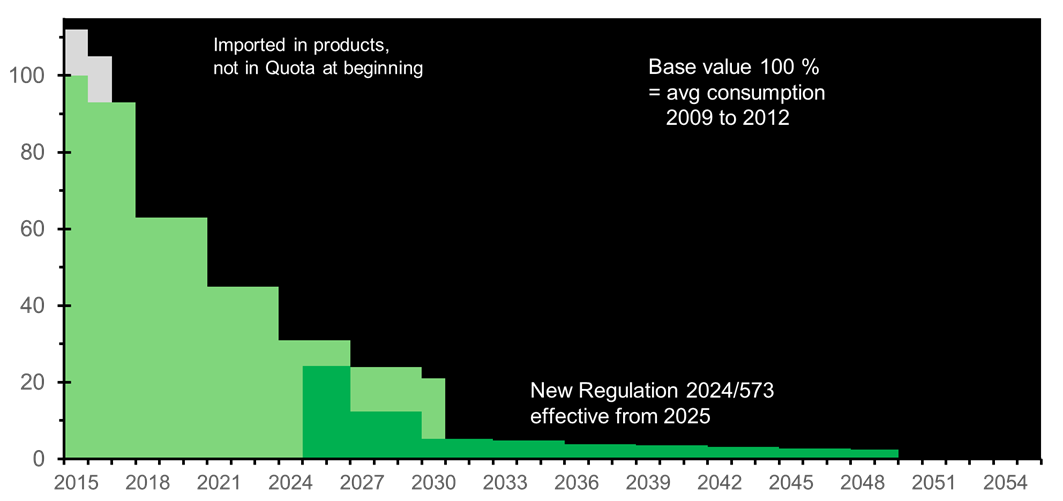
The new emission amounts for HFC are very close to those of the Commission draft, but down to 0 from 2050. Additionally the amounts from 2025 on do, different from now, contain amounts of medical dose inhalers (MDI). This will make availability even worse for other users.
Year | % 517/ 2014 | avg. GWP 517/2014 | % 2024/573 | avg. GWP 2024/573 |
|---|---|---|---|---|
2015 | 100 | 2200 | ||
2016 | 93 | 2046 | ||
2018 | 63 | 1386 | ||
2021 | 45 | 990 | ||
2024 | 31 | 682 | ||
2025 | 31 | 682 | 24,3 | 558 |
2027 | 24 | 528 | 12,3 | 282 |
2030 | 21 | 462 | 5,2 | 119 |
2033 | 4,8 | 110 | ||
2036 | 3,8 | 88 | ||
2039 | 3,5 | 80 | ||
2042 | 3,1 | 71 | ||
2045 | 2,7 | 63 | ||
2048 | 2,4 | 55 | ||
2050 | 0 | 0 |
The column "avg. GWP 517/2014" shows the estimated values up to now and reaches 462 for the year 2030 as average. The column "avg. GWP 2024/573" shows the estimated values calculated from the amounts of the new Regulation. There is only 119 left as average value for 2030, and from 2050 no HFC any more. Thus, the assumption made so far, that a GWP value up to 150 is sufficiently low, does not hold – not even for 2030.
The number of bans for refrigerants with high GWP in applications has been increased in the new Regulation. An X at "Safety exemption" in the following table means that local safety standards can lead to an exemption from the GWP limit. If a line follows with same application and year, higher GWP and no X, the ban is valid for this higher GWP value if safety standards apply.
Application | Safety exemption | Fluorinated greenhouse gases GWP > 2500 | Fluorinated greenhouse gases GWP > 750 | Fluorinated greenhouse gases GWP > 150 | No fluorinated greenhouse gas |
|---|---|---|---|---|---|
Reuse of refrigerant without recycling or cleaning | |||||
Service with recycling material | 2030 | ||||
Commercial refrigerators and freezers | 2025 | ||||
Stationary refrigeration, except chillers and except storage < -50°C | 2025 | 2030 | |||
Self contained refrigeration, except chillers | X | 2025 | |||
Service with virgin refrigerant on stationary refrigeration, except chillers | 2032 | ||||
Plug-in room air conditioning and heat pumps, self contained heat pumps, except chillers | X | 2025 | 2032 | ||
Plug-in room air conditioning and heat pumps, self contained heat pumps, except chillers | 2032 | ||||
Chillers ≤ 12 kW | X | 2027 | 2032 | ||
Chillers > 12 kW | X | 2027 | |||
Monobloc and other self contained air conditioning and heat pumps 12 .. 50 kW, except chillers | X | 2027 | |||
Monobloc and other self contained air conditioning and heat pumps 12 .. 50 kW, except chillers | 2027 | ||||
Other self contained air conditioning and heat pumps, except chillers | X | 2030 | |||
Other self contained air conditioning and heat pumps, except chillers | 2030 | ||||
Split air conditioning and heat pumps air/water ≤ 12 kW | X | 2027 | 2035 | ||
Split air conditioning and heat pumps air/air ≤ 12 kW | X | 2029 | 2035 | ||
Split air conditioning and heat pumps > 12 kW | X | 2029 | 2033 |